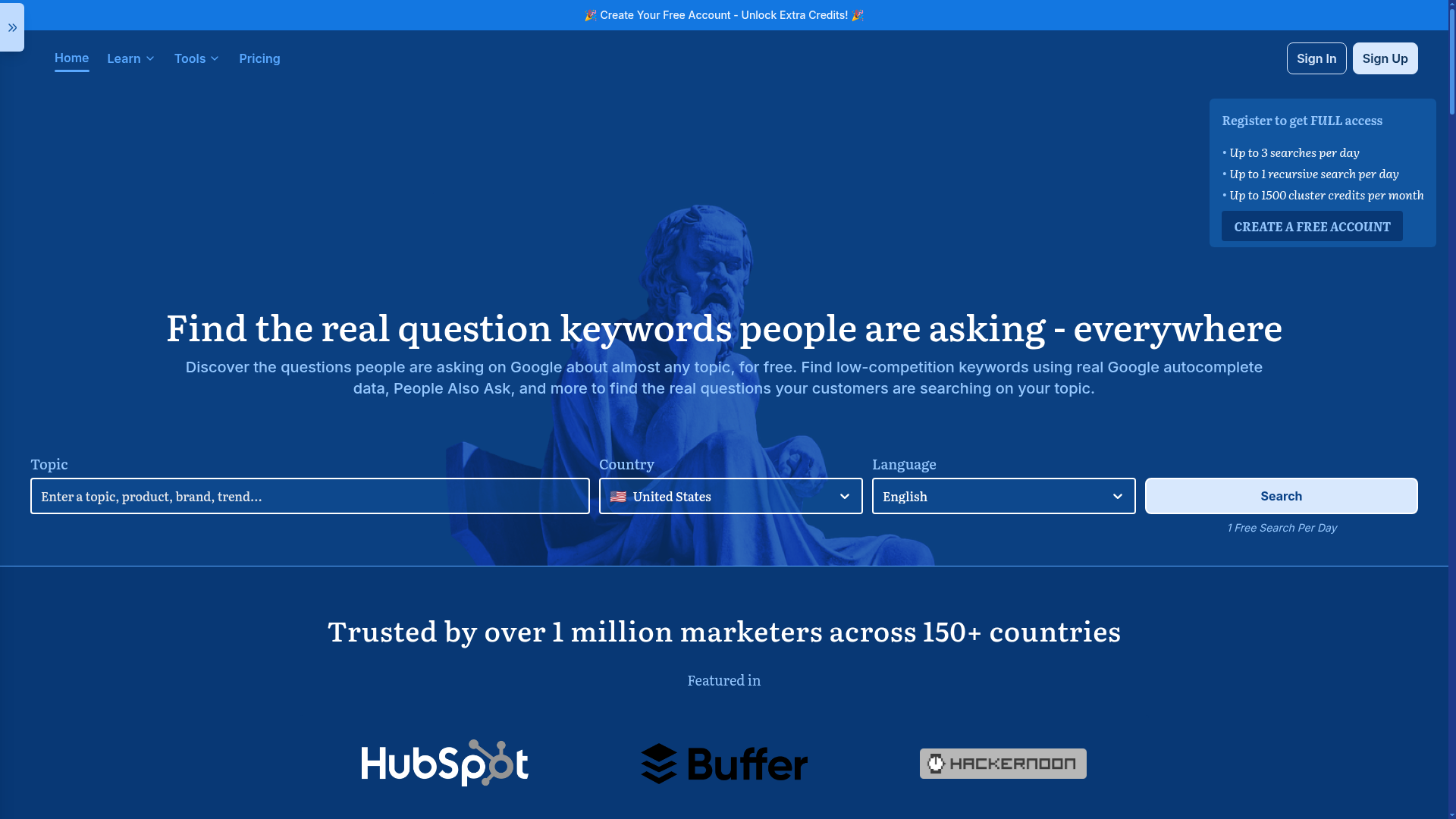
Answer Socrates is built for content creators, bloggers, and SEO-focused marketers who want to know what their audience is genuinely asking before they write a single word. Rather than guessing topics, you enter a seed keyword and get back the actual questions people are searching — grouped, prioritised by volume, and ready to turn into articles, videos, or social posts.
Question-first keyword research. Most keyword tools show you search volumes for terms. Answer Socrates shows you the actual questions behind the searches — the phrasing people use when they are genuinely trying to find something. That difference matters when you are writing content that needs to match search intent, not just rank for a keyword.
One-click content strategy. Enter a topic and Answer Socrates returns hundreds of related queries. Cluster them with one click and you have a full content plan — pillar pages, supporting articles, and FAQ content — organised by theme and search volume. What might take hours of spreadsheet work can be done in under a minute.
Trending topics discovery. Beyond standard keyword research, the Trending Topics feature surfaces what is spiking in real time across any country and language. Useful for creators who want to jump on a rising topic before it peaks, or need a hook for a social post that will feel timely.
AI search visibility tracking. The LLM Brand Tracker monitors whether your brand or content is being cited and recommended by ChatGPT, Perplexity, Gemini, Grok, and Claude — and tracks how that changes over time. For creators building authority in a niche, knowing whether the AI models are recommending you is increasingly relevant to where future traffic comes from.
Who Is It For?
Answer Socrates is most useful for creators who publish written content — bloggers, newsletter writers, and YouTubers who need article ideas — and for anyone doing SEO who wants to understand search intent rather than just search volume. The free plan is functional enough to test the tool properly before committing to paid access.
It is less suited to creators who work entirely within social platforms with no SEO component to their content, or businesses looking for enterprise-scale keyword database features — though it works well alongside tools like those.
Best Niches to Use With
Key Features
- Question Generation — turns a seed keyword into hundreds of real questions people search on Google, grouped by intent type
- Keyword Clustering — groups related keywords into topic clusters automatically, showing total cluster search volume and average CPC
- People Also Ask — surfaces the exact PAA questions Google shows for your keyword, ready to add to FAQs or article headings
- Trending Topics — finds spiking topics in any language and country, with content idea expansion built in
- LLM Brand Tracker — monitors your brand's visibility across ChatGPT, Perplexity, Gemini, Grok, and Claude over time
- Search Volume & CPC Data — shows volume, competition, and CPC data across all keyword outputs
- CSV Export — download your full keyword research and clustered results with one click
- Multilingual & International — works in any language and country for international SEO campaigns
Pros and Cons
- ✅ Free plan with one search per day — enough to properly evaluate
- ✅ Question-led research matches how people actually search
- ✅ Keyword clustering creates a full content plan from a single search
- ✅ Trending Topics is genuinely useful for timely content
- ✅ LLM Brand Tracker is a useful forward-looking feature
- ✅ Works in any language and country
- ❌ Free plan limited to one search per day
- ❌ Less suited to pure social-only creators with no SEO goals
Summary
Answer Socrates does one thing particularly well: it shows you what your audience is actually searching, not just what a keyword tool thinks is related. The combination of question generation, keyword clustering, and trending topic discovery in one free-entry tool makes it a practical starting point for any content creator who cares about finding topics that already have an audience. The LLM Brand Tracker adds a forward-looking layer that is worth monitoring as AI search continues to grow as a traffic source.
Visit Answer Socrates →